My Wedding at St James's Church, Spanish Place on Saturday 16th December 2023

The livestream of our wedding can be seen from the folowing link:

https://www.youtube.com/watch?v=ZosYPl7dLH4

Order of Service 

Entrance of the Bride

Trumpet Voluntary    John Stanley (1712 – 1786) 

Introduction and Welcome 

Opening Carol

Once in Royal David’s City   

Opening Prayer 

First Reading

A reading from the Book of Ruth 1: 1-22

Psalm

Ecce sic benedicetur                    Cristóbal de Morales (1500 – 1553)

Ecce sic benedicetur omnis homo qui timet Dominum:
et videas filios filiorum tuorum.
Pax super Israel.
Alleluia, alleluia.

Behold, thus is the man blessed who fears the Lord:
May you see your children's children.
Peace be upon Israel.
Alleluia, alleluia.

Second Reading

A reading from the first letter of St Paul to the Corinthians 12:31-13:8

Gospel Acclamation

Alleluia

Exsultate justi in Domino            Lodovico da Viadana (1560 – 1627)

Exsultate justi in Domino, rectos decet collaudatio.

Confitemini Domino, in cithara; in psalterio decem chordarum psallite illi.

Cantate ei canticum novum: bene psallite ei in vociferatione. 

Rejoice in the Lord, O ye just; praise befits the upright.
Give praise to the Lord, on the harp; sing to him with the psaltery, the instrument of ten strings.
Sing to him a new canticle, sing well unto him with a loud noise.

Gospel

A reading from the holy Gospel according to John 2:1-11

Homily 

The Rite of Marriage

Exchange of Vows

Blessing and exchange of rings 

Bidding Prayers

The Lord’s Prayer

Soloist

Ave Maria Franz Schubert (1797-1828)

Nuptial Blessing

Final Blessing 

Recessional Hymn

Praise My Soul The King Of Heaven

Signing of the Register 

Gaude Virgo Maria                       Tomás Luis de Victoria (1548 - 1611)  

Exit of the Bride and Groom 

Toccata from Symphony No.5 in F Charles-Marie Widor (1844-1937)

Traditional Carpet Weaving - using a tufted pile

Prayer carpets draw our attention towards God. As I was weaving this rug I meditated on my own prayer,

Crucify my feet Lord, so that I shall only walk Your path,

Crucify my hands Lord, so that I only do Your work,

Crucify my head Lord, so that my thoughts are only of You,

Crucify my heart Lord, so that all that I do is in You.

I used traditional Persian/ Kurdish carpet weaving tools and methods of working. I set up a warp on a small loom and created a tufted pile using what is commonly referred to as a Turkish knot.  I used a combing tool for beating down the woven rows - which also helps to secure the knots in place. The cutting knife is used to cut the wool to continue tying knots. It also had a small hook on the end for passing the wool through the warp. The scissors had an angular bend to enable the excess wool to be trimmed off and to cut the carpet pile down to the required height.  I used lambs wool to symbolise Christ, the Lamb of God.

(4 x 4 inches + fringe)
Making Brown Scapulars of Mount Carmel

Using 100% pure lambs wool, dyed brown with brown tapes. Made with hand sewn images the sacread heart and cross (to hang over the front of chest and back).


Weaving your heart out

Here is my first attempt at making a flat woven carpet. I used cotton thread for the warp (vertical) and wool for the weft (horizontal). For my next project I am going to take Pictish key and step patterns and translate them into my weaving using the hand-dyed thread that I made a few months ago. I liked using this table top loom as it made it achievable in a couple of days.

Making a Christian Head Covering

Taking a piece of fabric, roughly 12 x 18 inches, tapering two sides for the ties and a straight hem on the square piece at both ends. I pleated each end of the square piece and slotted them into the ties and sewed together to secure in place. I envisioned what I wanted to create from a drawing by Leonardo da Vinci, A Study of a woman’s head (c.1490) and I drew my own version of it in Silverpoint.

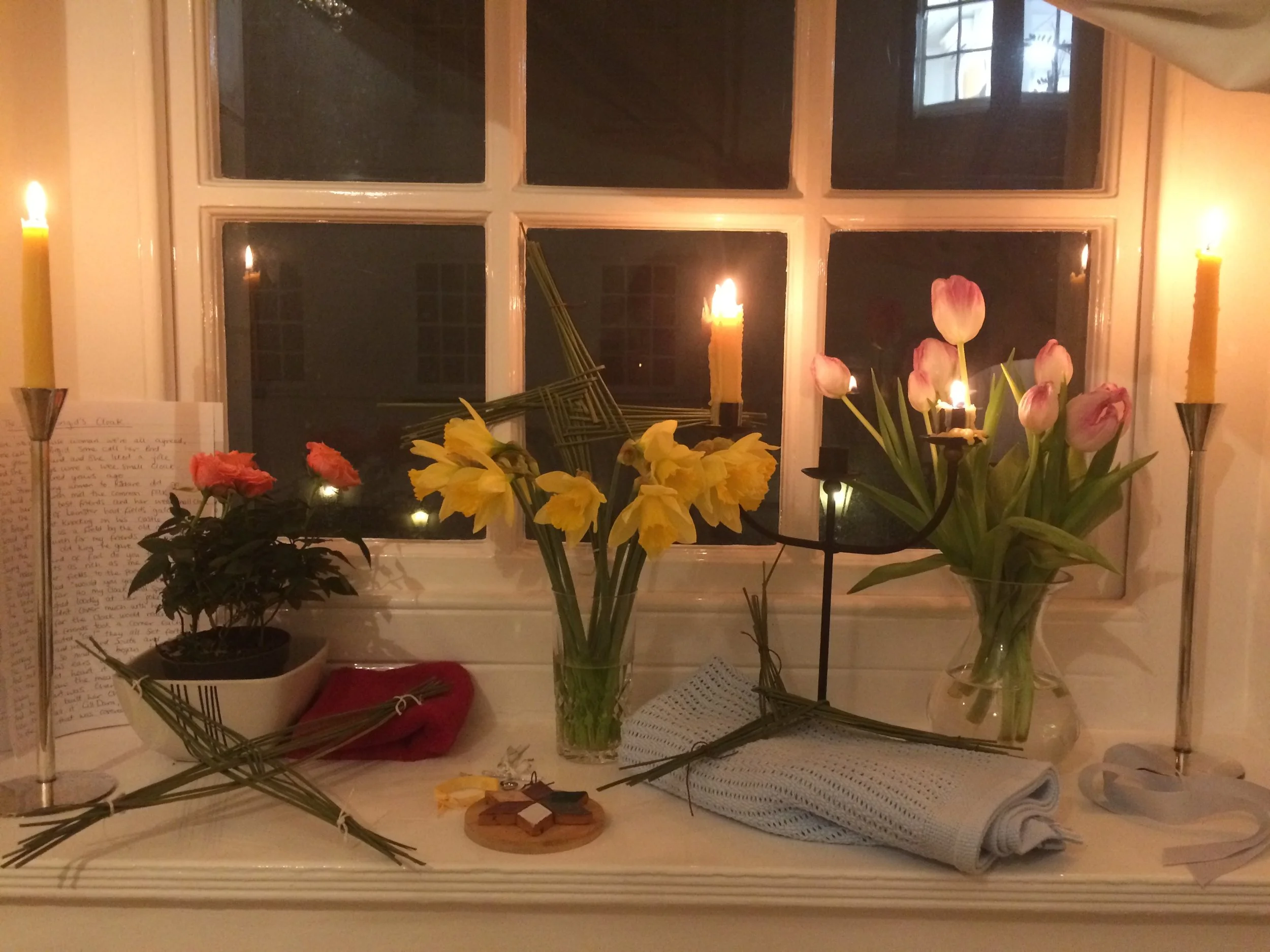
Making St. Brigid's Day Crosses

Made with hand-picked rushes from Ireland.

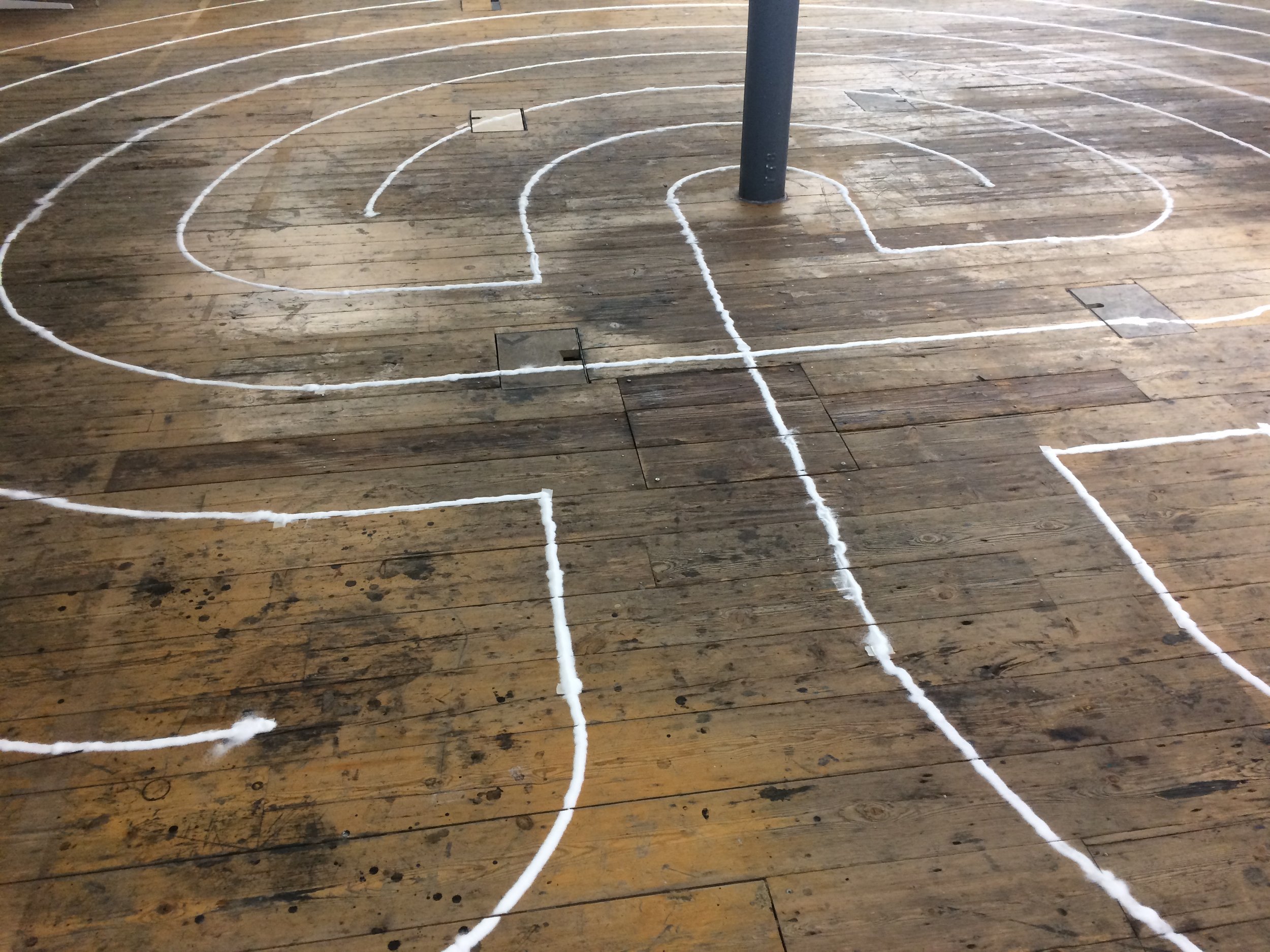
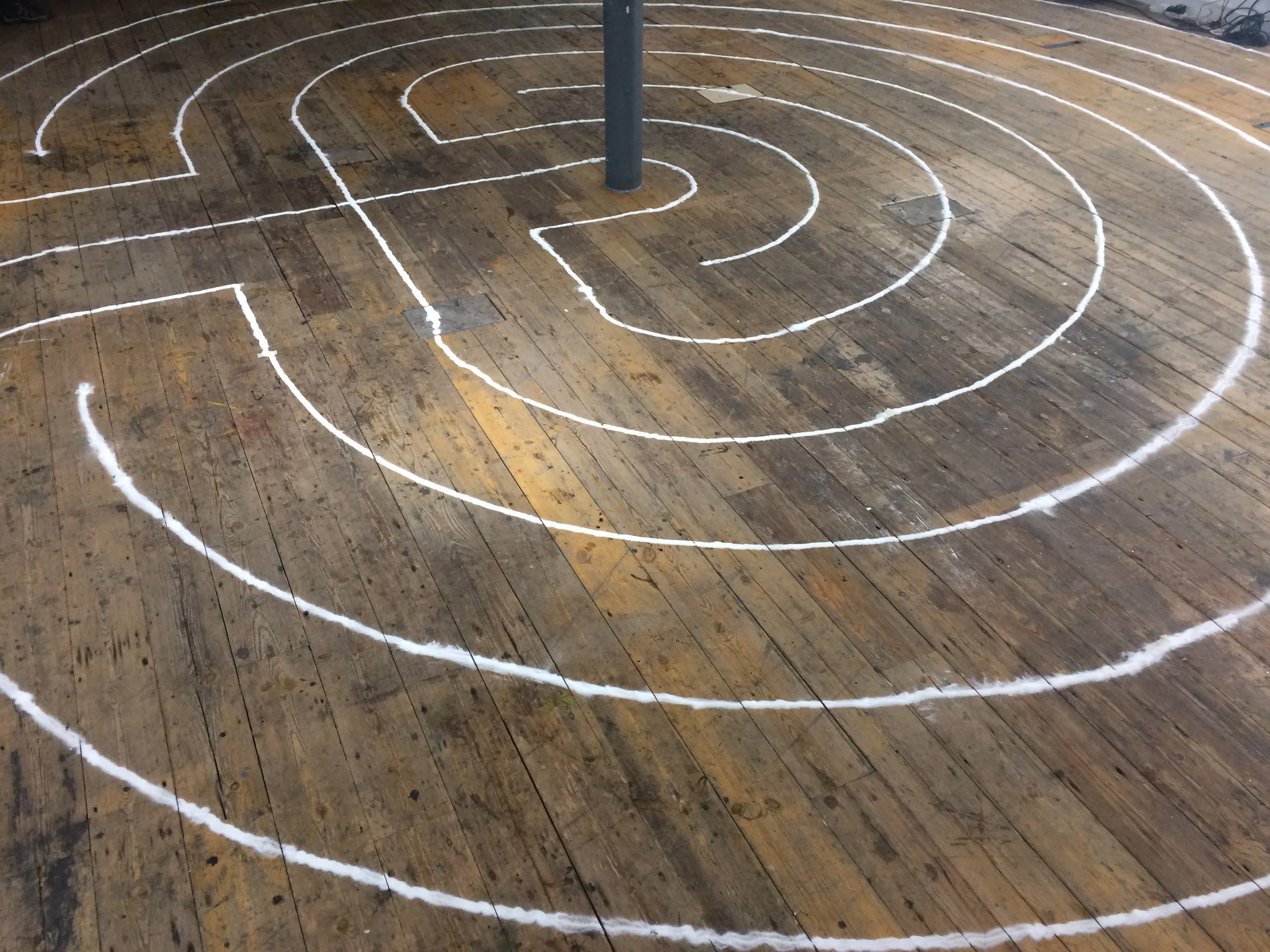
Labyrinths: A walking meditation on the journey of life, death and rebirth

There are medieval labyrinths that can be seen in the gothic cathedrals of Chartres, Reims and Amiens in France. In the Christian tradition they can represent several things, such as a journey of decent, into a deeper place for prayer and contemplation. Parallels can be drawn with Christ’s, “Decent onto Hell” (also known as the “Harrowing of Hell”). The decent into the underworld brings about a powerful transformation and represents a spiritual death and rebirth. When this occurs, genuine growth and transformation occurs.

I notice how the beginning of this transformation lies the cross. A cruciform shape extended outwards.

In the Christian tradition, the labyrinth can also represent an underground cave or womb of the Blessed Virgin Mary. The womb in which we are spiritually reborn. The circles can be compared to the turning of a child in the womb during pregnancy.

The Biblical figure of Nicodemus is also associated with the same themes of death and rebirth, as scripture tells us. In art, Nicodemus is often depicted upon a ladder, assisting in the removal of the dead body of Christ from the cross. 

During the 16th century labyrinths began to be made with dead ends, or multiple endings, these became mazes. You become lost. This represents a change in world view that was occurring at that time. Labyrinths have only one path to follow, they are complete, whole and contained. Therefore the change must be internal.

The centre of the labyrinth is considered to represent the Holy City or the Spiritual Jerusalem.

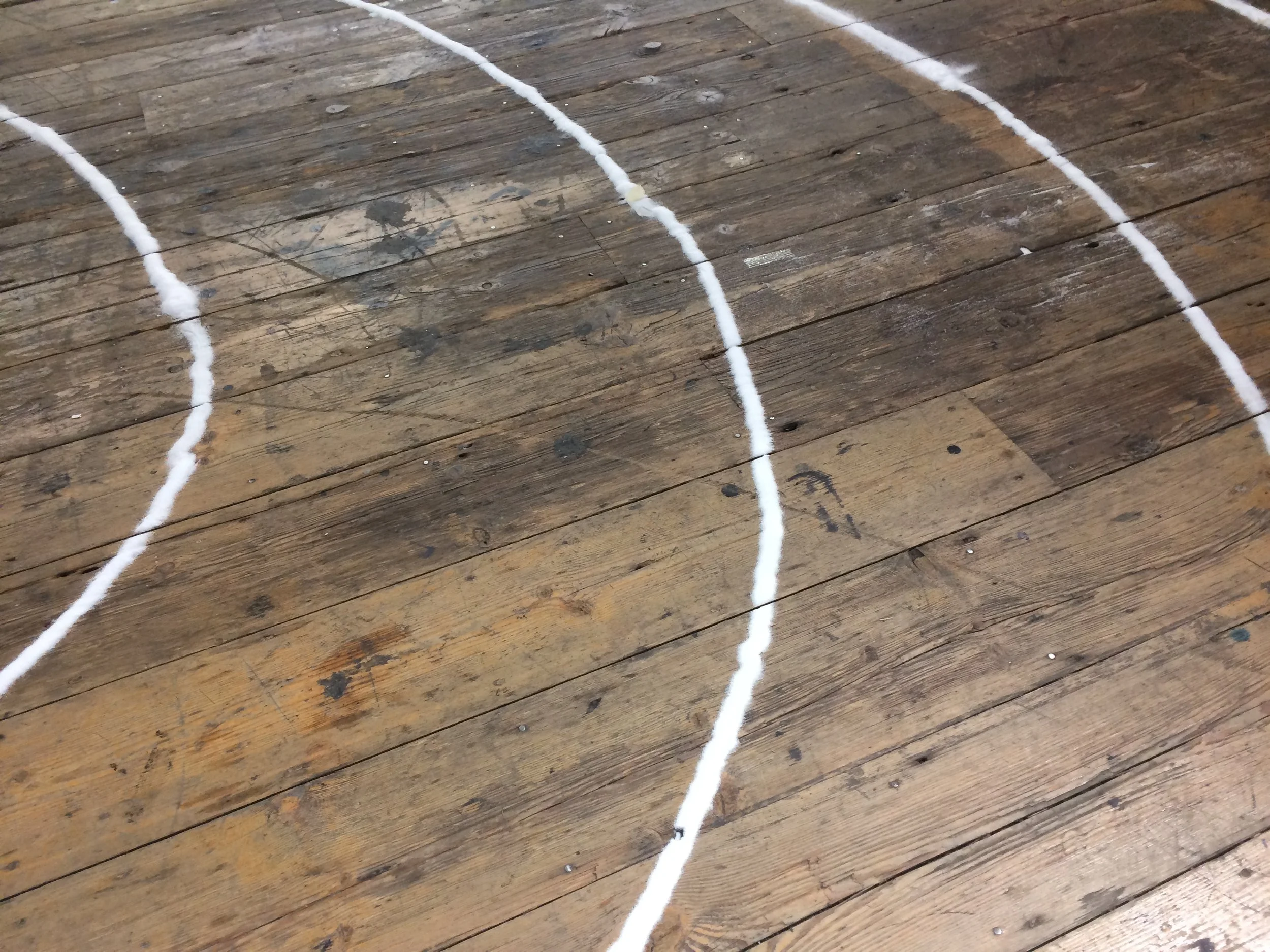
This labyrinth was made with salt for ease of use. However this was also symbolic as salt is Biblically associated with sin.