Saint Benedict Medal

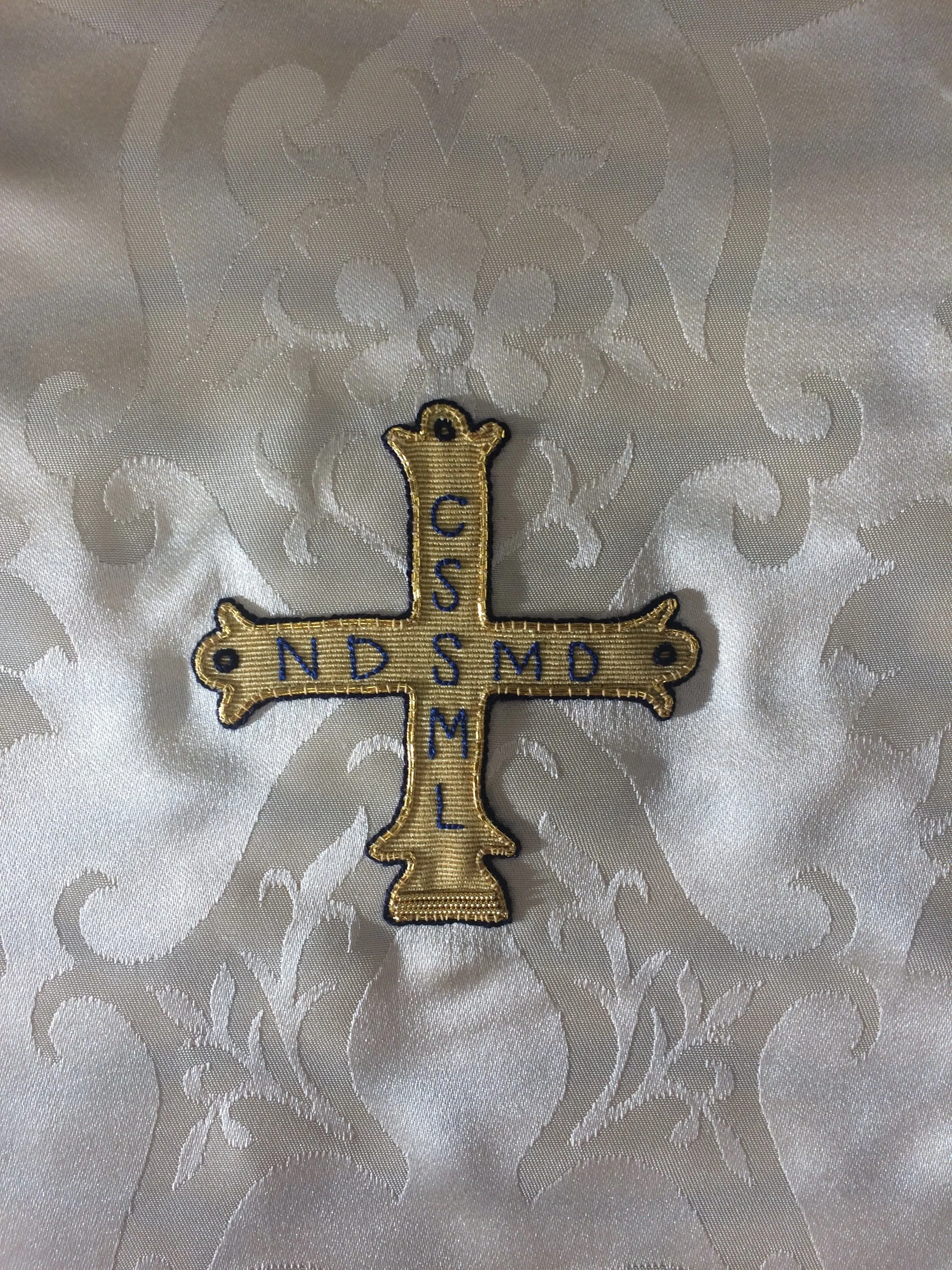
I have been working on an embroidered medal of Saint Benedict for Watts & Co. to be used either as part of a stole or altar frontal.

Saint Benedict is regarded a founder of Western Christian monasticism and lived in the 4th-5th centuries. The “Rule of Saint Benedict” contains the set of rules that his monks should follow.

Tradition holds that the medal protects from curses, evil and vice, protects against disease and protects good health. The medal is often included as part of a rosary or worn separately.

The front of the medal shows Saint Benedict holding a cross in his right hand and in the left his rule for monasteries.

The reverse side contains the following exorcism prayer. The first letters of which are inscribed on the cross and around the circumference of the medal.

In Latin it reads as:

 Crux Sacra Sit Mihi Lux.

Non Draco Sit Mihi Dux.

Vade Retro, Satana!

Nunquam Suade Mihi Vana.

Sunt Mala Que Libas.

Ipse Venena Bibas.


This translates to English as:

May the Holy Cross be my light.

May not the dragon be my guide.

Begone, Satan.

Suggest not vain things to me.

Evil is the cup thou offerest.

Drink your own poison.

Here I have worked the reverse side of the medal on a damask background, using gold threads, purl-purl, applique and stranded cotton.

On the front side of the medal, to Benedict's right, below the cross, is a poisoned cup. This is a reference to the legend that hostile monks attempted to poison him, and the cup containing poisoned wine shattered when the saint made the sign of the cross over it. To his left, below the rule, there is the raven that carried off a loaf of poisoned bread. From this is derived the tradition that the medal protects against poisoning.
Royal School of Needlework Graduate Awards Ceremony

I was delighted to attend Hampton Court on 5th July 2021 to receive my Diploma in Technical Hand Embroidery from the RSN. I also received a ‘Special Mention Award’ for having achieved 93% in Blackwork for my Matador (see Gallery).

Click here for the RSN article:

https://royal-needlework.org.uk/graduate-awards-for-cd-and-future-tutors/ 

Watch the awards ceremony here:

https://www.instagram.com/tv/CQ8pk-_IpDk/?utm_source=ig_web_copy_link


Kenmare Lace

Kenmare Lace was introduced to Kenmare due to influences from French and Venetian laces and grew to prominence in Ireland and the world in the 1800s due to the support and skills of the Sisters of The Poor Clare’s Convent.

Here I have worked a sampler and flower motif designed by the Kenmare Lace and Design Centre in Co. Kerry, Ireland.

Kenmare Lace -Sampler and flower.png

My sketchbook studies of The Spanish Masters

I have been studying the Masters of Spanish Painting based on a collection at the Museo del Prado in Madrid. Painters include, Murillo, Zurbarán, Velázquez, Rivera, Luis de Morales, Alonso Cano, El Greco, Claudio Coello, Pedro Berruguete, Pereda and Goya, to name a few.  

Using various grades of lead pencil from 2B, to 4B and 6B (i.e. from hard to soft) gave me flexibility of movement and allowed me to model the forms with greater sensitivity. Using a rubber pencil I was able to obtain control of the light and shadows and gain a deeper understanding of the ‘chiaroscuro’ effects (that is shadows of light and dark cast on an object or person from an external light source).

I am aware that these paintings (using the chiaroscuro approach) employ a different philosophy to those used in icons, where the light comes from within. This is written or demonstrated by layers of colour built up from dark tones forming the under-painting, and lighter tones forming the top layers, eventually reaching white.

Overall, I noticed the images were very emotional and sentimental. Yet, very enchanting and sweet to behold.

Praying with the daffodils

Having recently completed the painting ‘St. Francis preaching to the birds’ (see Gallery), I was inspired taking a walk through my local park where I came across some daffodils.

It made me stop and think of the beautiful symbolism of prayer. They are all completely open and turned outward facing God the ‘Son’. They all stand straight and proud, in joy and happiness to be giving our Creator all the love and praise in perfect justice. The trumpet shape made me think of ears listening to the word of God and obeying His commands. Pray without ceasing.

Resurrexit! Sicuit dixit! Alleluia! 

Praying with the daffodils.jpg

Carrickmacross Lace

I wanted to learn this form of lace because these techniques can be used to make beautiful embellishments to communion or wedding veils.

The base layer is a net, with organdie laid on top. The design is then applied using a series of couching stitches and then the organdie is cut away in the background areas to expose the mesh. A fine thread is weaved in between the net to create a lacy look. This creates an illusion of depth and layering of the design (i.e. foreground, middle-ground and background). It’s finished off with a few eyelets in the mesh and loops around the edges to give it a nice finished border.    

Here I have used the harp and shamrock pattern designed by the Carrickmacross Lace Gallery in Co. Monaghan, Ireland.

Traditional samplers are making a comeback!

Traditionally, embroidery and cross-stitch techniques were taught by making samplers of a variety of stitches on a linen canvas. The focus was on technique and accuracy, rather than design. The sampler method also develops the inner virtues of patience and diligence. This is the reason I use this method to teach embroidery in my children’s classes.

Samplers also give you the opportunity to play around with the stitch to create different effects, for example; by varying the thread thickness (adding more or less strands of thread in the needle), adding multiple colours of thread in the needle to create a mottled or shaded effect and by playing around with the pattern size. This in turn, enables you as the designer to make better, informed decisions in the design phase of your work. Modern teaching methods go straight to the design phase and skip this very important stage in learning development.

Samplers are also beautiful in their own right; they can be framed and hung or used as a fireplace guard or screen. They are also collector’s items – I have seen several being sold at antique fairs around the country. Some samplers can simply be a Bible quote or poem.

Canvaswork sampler.png

Repairing a chasuble for the feast of the Sacred Heart

Every now and again I’m asked to repair a really stunning chasuble. With old vestments, critical decisions need to be made regarding how much you repair and ‘make good’ with what’s there and how much you replace entirely.  Thankfully, in this case the goldwork embroidery was in pretty good condition and the only part that was worn was the area at the bottom, which is held frequently by the altar server. In this case I discreetly placed a piece of matching coloured silk underneath the tear and delicately sewed it together.

My vintage 1914 Singer 99K

Recently I decided I wanted to invest in a vintage Singer for my studio.  A manual machine (non-electric) was a must! A friend put me in touch with Lizzie Lenard who helped me find this beautiful machine, a 1914 Singer 99K. She has wrote this very detailed article about it’s components and fixtures. It’s been beautifully cleaned and will be a wonderful addition to my studio. I have attached Lizzie’s article below:

http://lizzielenard-vintagesewing.blogspot.com/2020/10/1914-singer-99k.html

1914 Singer 99K.jpeg
1914 Singer case.jpeg